
Google search

Custom Search

Saturday, February 6, 2010

Why have Russian Cosmonauts never landed on the Moon?

Question posed by Happydaiz

This is a political question, rather than a scientific one, and I'm not particularly politically minded, but I'll do my best to give a measured response. Any readers must, however, bear in mind that much of this post will be based on opinion rather than fact, and I would welcome comments from people better educated in the historical and political aspects of this theme.

The first manned moon landing occurred on 20th July 1969, when Apollo 11's lander, Eagle, touched down in the Sea of Tranquillity. The decades leading up to this were ones of worldwide tension and political conflict as, in the aftermath of World War II, the major powers of the world (mainly the USSR and the USA) embarked upon an informal programme of mutual distrust and competition known as the Cold War. The main players' militaries never officially clashed, and the conflict was played out through espionage and propaganda, strategic military deployments and coalitions, and technological competition including arms races and the Space Race.

The Space Race saw the Soviet Union and the United States of America locked in an intellectual and technological battle to conquer various frontiers of space, and became a significant part of the rivalry between the two nations. Efforts began with exploring space remotely, using artificial satellites, and progressed to sending human beings into space, with landing a man on the moon being seen as the final, golden, objective. Space was an important frontier to conquer from many perspectives, not least from one of political displays of might and technology, and possibly most strongly from one of military potential.

Whilst the US had sent the first animals into space in 1946 using captured German V-2 rockets, the Soviet Union made a good start in the race, being ahead of the US in its development of intercontinental ballistic missiles (ICBMs), a grandparent of today's space rocket technology. On 4th October 1957,  the Soviet Union launched Sputnik 1, the first artificial satellite to be successfully inserted into orbit. A month later they launched Sputnik 2, which included the first animal to be placed in orbit around the Earth. The US caught up three months later when it successfully launched its first satellite, Explorer 1.

The US overtook the USSR when it launched the first communications satellite, Project SCORE, on 18th December 1958. In 1960, the USSR launched the first dogs into space that were to survive and come back again.

In 1961 (12th April), the first human, Yuri Gagarin, was sent into space, representing a massive space race victory for the USSR as he orbited the Earth for 108 minutes. On 20th February of the next year, John Glenn successfully orbited the Earth as America caught up.

In June 1963, the USSR put the first woman (Valentina Tereshkova) into space, and in July the US satellite Syncom-2 became the first satellite in geosynchronous orbit, representing a leap forwards in global telecommunications technology.

After the US announcement of the Apollo moon-landing programme, the USSR stepped up its efforts, and in October 1964 launched the first three-man crew into space*. The first spacewalk was carried out on 18th March 1965 by Russian Alexy Leonov.

The US Apollo programme was developed as a project to capture public imagination as well as ensuring spin-off scientific and technical benefits, and in 1968, the US leapt to the front of the space race when the first humans, Jim Lovell, Frank Borman and Bill Anders, orbited the moon (and celebrated Christmas in space) shortly after the USSR had sent the first animals around the moon.

A series of launch failures and cosmonaut deaths held back the Russian fight for first place, although Soviet probes (Lunar 9 was the first, on 3rd February 1963) did reach the moon before any US craft. On 21st July 1969 Neil Armstrong became the first human being to set foot on the moon, after having landed the previous day.

Many people see this event as being the end of the space race, although such a statement could be debated through the night with no hope of conclusion: Many Russians claim that by sending the first man into space, they won the 'race' back in 1961.

Apollo 11 was followed by five more lunar landings, but US attention was largely turned to other ventures, including the Space Shuttle. The Cold War subsided, and the two nations continued their space programmes less driven by the desire for one-upmanship that had led to the moon landings. Attention returned to areas of space closer to home, largely for military purposes, but also for reasons of cost and politics. A large number of people see the real end of the Cold War as having occurred in 1975 when the Soviet Soyuz-19 and the American Apollo docked together, allowing astronauts from the two nations to work together for the first time.


So why have no Russian cosmonauts gone to the moon?
This is the bit which is mostly speculation, but it seems to me that once America had 'won' the race to the moon, it didn't make economic or political sense for the USSR to continue chasing a goal that had already been achieved. In much the same way that America's own moon landing programme fizzled out and stopped, the USSR just didn't have the public or political backing to spend the time, effort and money on a venture which was largely undertaken in the first place as a display of power and technological superiority.


* This was also the first non-spacesuited trip into space.

Saturday, January 30, 2010

Beautiful Moon

Has anyone else noticed that the moon looks particularly beautiful tonight? No, there's nothing in the air, and it's not because that girl/ boy at work/ school has finally noticed you in the corridors. That full moon really is around 30% brighter and about 14% bigger* than any other full moons that you've seen for a while, or will see for at least another year.

Why's that?
The moon is currently at perigee, which is the point in an object's orbit around the Earth at which it is closest to the Earth**. This happens once a month, but the moon can be in different phases of its cycle when that happens. Every now and then, it happens when the moon is full, and that really gives us something to look at.

But that's not all...
The moon being at perigee and being full is a nice enough coincidence on its own, but there's another that we can take advantage of. Near to the current astounding full moon, you should be able to see a bright, noticeably red/orange star. Well, it's not a star: It's Mars, and it's at opposition. This is when Mars is on the opposite side of the Earth to the Sun, which means that Mars and Earth are about as close as they get. This, of course, means that Mars also looks bigger and brighter in the sky

The photo above is, for once, one I took myself. It's my first attempt at moon photography with my Nikon D60 DSLR camera (with its supplied lens), so I'm not too upset with it! The moon is fairly obvious, but you can also see Mars making an appearance towards the top of the image.


* In all honesty, it's not really something that you'll notice with the naked eye, but it's a pretty decent excuse to go outside, look at the sky and think about what's going on up there... and maybe take a picture or two.
**The opposite of this point, the furthest that a body is from the Earth during an orbit, is called 'apogee'.

Saturday, January 23, 2010

Is Jupiter Earth's protector?

Question posed by Robin


Yes and no.


Yes
Popular wisdom paints a picture of Jupiter as a gigantic vacuum cleaner, whizzing around the solar system and sucking up dangerous lumps of rock and ice before they can do us any harm. To an extent this is true: a study in 1994 showed (through computer modelling) that if Jupiter had formed to be closer to the size of Neptune or Uranus, then Earth could have expected around a thousand times as many impacts with long-period comets than we do with a Jupiter of the size that we're accustomed to.

Jupiter can clear away space debris either by impacting with it or drawing it into a wider orbit, or by slinging it out of the solar system altogether.


No

A more recent study, completed in 2007, went a step further than the one mentioned above, and removed Jupiter from the solar system altogether. The results showed that Earth would experience fewer collisions with no planet at all in Jupiter's orbit. Both studies agreed that having a smaller planet in place of Jupiter would leave the Earth worse off*.

Jupiter's massive gravitational field can also disturb comets and other objects further out of the solar system, possibly causing them to fall towards the inner solar system and crossing the Earth's orbit. Both of the studies mentioned so far only looked at comets. Less than 5% of historical Earth impacts have been due to comets; the rest have mostly been collisions with asteroids. Our solar system's asteroid belt lies relatively close to Jupiter and is affected by its gravity, which sometimes causes asteroids to collide and be knocked into more eccentric orbits that cross Earth's path. General feeling at the moment seems to be that if Jupiter simply wasn't there, the asteroids would be more stable, reducing the chance of impacts from asteroids.


Further reading


* But they disagreed on how worse off.

Changes to Blogstronomy!

Blogger, the site that hosts Blogstronomy, has added 'page' functionality for its users. From your point of view, this means that if you look towards the top of this page, just below the title banner, you'll see a row of links (currently four) that will take you to a number of static pages that I have set up in the hope that you can find any information that you might be looking for. So far I've added the following:

  • Home - Just takes you to the main blog page
  • Ask a question! - Takes you to a form that you can use to ask a Blogstronomy-related question
  • About Blogstronomy - A few words about the blog, why I decided to set it up etc
  • Contact me - Ways of getting in touch with me should you feel the need
If you think I could add any more links with useful information (I can have up to 10), or if you'd like to see something added to the pages that are already there, please say so! 

Thanks for reading, and please keep the questions coming in!

Thursday, January 14, 2010

How big is Pluto? (and is it a planet?)

How big is Pluto? And is it really a planet? if not, what is it?
Question posed by William

Pluto is the smallest planet in our solar system. It's a bit more than 2300 kilometres in diameter*, which is about one-sixth the diameter of the Earth. To put that in perspective, if you could shrink the Earth down so that it was about the size of a football, Pluto would be about the size of a table-tennis ball. Pluto is even smaller than our Moon.

I went into a bit more detail on why Pluto is no longer a planet in an older blog post, but I'll go over the basics here as well: Pluto used to be called a planet, but that was when nobody had really decided what a planet actually was. Back in 2006 the International Astronomical Union (IAU) decided on a definition which meant that Pluto was no longer included. The IAU also decided on what Pluto (and other objects like it) should be called, and because of that, Pluto is now known as a 'dwarf planet'. There are currently five known dwarf planets in our solar system, including Pluto.


This image (nabbed from another website- click to visit) shows the size of Pluto in relation to the Earth and its Moon, as well as a couple of other solar system bodies (both Sedna and Quaoar are candidates for the title of 'dwarf planet', but we need to collect more information about them before we can be sure).


* The diameter of a planet is the distance from one side to the other if you went straight through the middle of the planet.

Monday, January 11, 2010

What's the difference between a new moon and a lunar eclipse?

Can you explain to my boyfriend what a lunar eclipse is and why it's different from a new moon every month?
Question posed by Charlene

What is a New Moon?
In the following section I'll ask you to 'imagine', but there's no real reason why you can't actually do the things I'm asking you to imagine if it would help to see what's going on.

Imagine standing in a darkened room with a football held out in front of you at arm's length. Now imagine a mate of yours is on the other side of the room holding a torch, and they're shining it at you. With the football still held out at arm's length, slowly turn on the spot, keeping your eye on the surface of the ball in front of you. What happens?

When you're facing in the opposite direction to your mate with the torch, you should see that the part of the ball that's facing you is lit up entirely*.
As you turn slowly on the spot, you should see a crescent of shadow creeping around the part of the ball that's facing you, so that less of the visible surface of the ball is directly lit by the light from your mate's torch. As you turn to face the torch-wielder, less and less of the ball is lit up (from your perspective) until, when you are directly facing the torchlight, the opposite side of the ball to you is lit up, and the side that's facing you is in darkness.
As you continue you turn, now to face away from the torchlight you'll see a crescent of light appear on your ball's face, growing until, as you face away from the light, the entire face of the ball is lit once more.

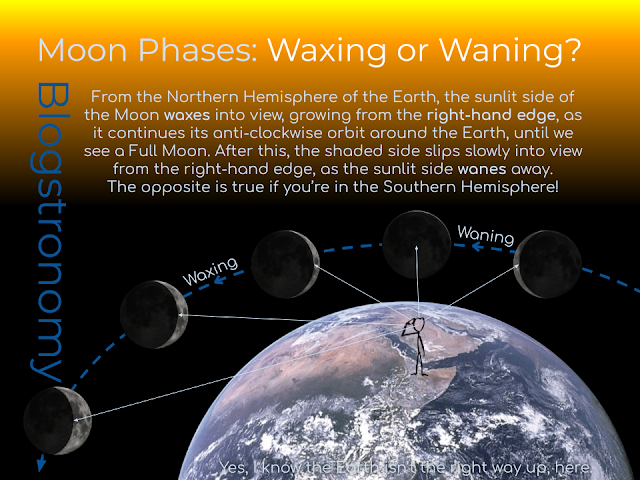
This is exactly what happens as the Moon orbits the Earth (or any other body orbits any other body!): The Moon is always (roughly) half-lit and half-shaded, but because of the movement of the Moon around the Earth, how much of the lit area we see changes due to our perspective. The diagram below may help to illustrate this (click to go to the originator's website).


A new moon is the time in this cycle when the Moon lies between the Sun and the Earth and so the Moon appears to us to be in complete darkness. In reality, the opposite side of the moon to us is fully lit, and the side facing us is in its own shadow.


What is a lunar eclipse?
Imagine again the situation in which you are holding your football at arms length (feel free to have a rest if you're tired...), and your friend is shining a torch at you from the other end of the room. If you move the torch, ball and your own head around so that they are in a straight line, your head will block some of the light from falling onto the face of the ball that would otherwise be fully lit.

When the Moon is on the opposite side of the Earth from the Sun, sometimes the Earth's shadow gets in the way, and what should be a full moon ends up with a curved slice 'missing' from it (a partial lunar eclipse), or being completely covered by the Earth's shadow (a full lunar eclipse). The image below may help to clarify this:


The Earth, Sun and Moon don't orbit each other in exactly the same plane**, so they don't always line up like this. That's why we don't see a full lunar eclipse every month- the Earth's shadow only relatively rarely crosses the surface of the Moon.


So what's the difference?
  • New moons occur because of our changing viewpoint of the Moon; lunar eclipses occur when the Earth gets in the way of the light from the Sun and stops it hitting the Moon.
  • New moons occur when the Moon is between the Sun and the Earth; lunar eclipses occur when the Earth is between the Sun and the Moon.

Other interesting bits
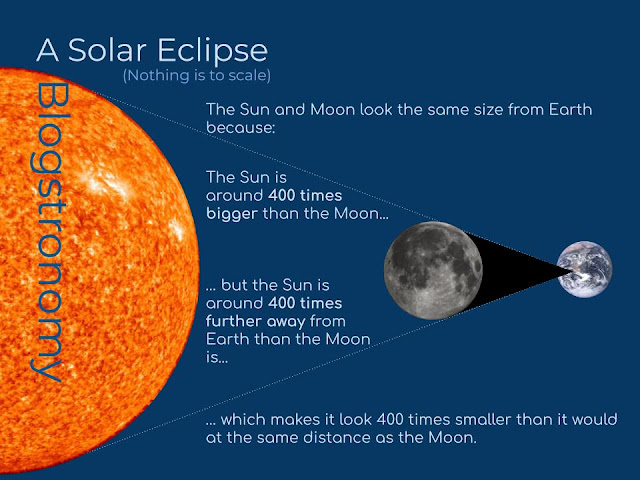
  • The relative sizes and distances of the Earth, Sun and Moon mean that the Earth's shadow covers the Moon almost perfectly during a total lunar eclipse, and the Moon covers the Sun almost perfectly during a solar eclipse. This is not due to any special effects of the universe; it's just a remarkable coincidence.
  • The above coincidence is made even more remarkable by the fact that the Moon is moving away from the Earth. This means that in the far past eclipses were less dramatic as the Moon appeared larger, and that in the far furture, eclipses will be considerably less dramatic as the Moon will appear smaller (and will not, for example, be able to cover the entire disc of the Sun): we are in a unique position, both in space and time.
  • Lunar eclipses sometimes appear red, due to refraction of light by the Earth's atmosphere.
  • There are many other moons in our solar system, but Earth's Moon is much bigger, relative to its parent planet, than any of the others.


Have a question about this topic? Comment below! Got an astronomy related question of your own? Ask it here.


* As long as your head's not in the way of the light, of course.
** A 'plane' is a flat, two-dimensional (imaginary) slice through space: imagine marbles rolling around on a table top- they're all moving in the same plane. If you could imagine slotting two pieces of card together and an angle, and being able to roll marbles on the two separate sheets of card whilst at angles to each other, this would give some idea (although quite exaggerated) of what I'm talking about!